Typing Research
Is Typing Muscle Memory? What Science Actually Shows
Short answer: typing uses “muscle memory” in the everyday sense, but the memory is not stored in your finger muscles. Practice builds procedural, largely implicit control that lets familiar key sequences run with less conscious attention.
That automaticity is partial. Choosing words, composing an argument, coding, noticing errors, and handling unfamiliar sequences still require active control. Your ability to do the movement can be better than your ability to describe the keyboard layout.
What “muscle memory” means in typing
“Muscle memory” is a convenient label for a learned movement that becomes easier to perform without thinking through every step. A medically reviewed Cleveland Clinic overview classifies it as procedural, non-declarative memory and emphasizes that the brain and nervous system store the learned pattern—not the finger muscles. It also says there is no single timetable for establishing or retaining it.
For typing, procedural control can include several related skills:
- reaching a key without visually searching for it;
- using a repeatable finger for a letter or sequence;
- preparing one movement while another keypress is finishing;
- producing familiar letter pairs and words with steadier timing; and
- using physical feedback from the keyboard to keep the hands oriented.
These are not one indivisible “typing program.” They can develop at different rates and behave differently when the text, device, language, or task changes. Practice should therefore build stable, accurate patterns, expose them to varied text, and check whether they transfer beyond one memorized test.
Your fingers can know more than you can explain
In four experiments, Snyder and colleagues tested skilled typists' explicit knowledge of QWERTY key locations using free recall, cued recall, and recognition. Their conscious maps were incomplete and inaccurate even though they could type well. In a fourth experiment, 24 experienced QWERTY typists briefly learned Dvorak, helping the researchers contrast newly acquired explicit knowledge with the implicit knowledge supporting established skill. The study's conclusion was not that typists know nothing about keyboards. It was that skilled action can rely on knowledge that is difficult to report explicitly.
That is why “Which finger types B?” may make you pause even when you just typed the letter correctly. Asking for a verbal answer changes the task. Normal typing turns a word into coordinated keystrokes; a keyboard quiz asks you to inspect and report part of that coordination.
This does not make typing unconscious. You still choose what to type, monitor the screen, decide whether an error matters, and correct it. The motor details can become less available to conscious inspection while the overall action remains intentional.
Skilled typing has an outer loop and an inner loop
Typing researchers Gordon Logan and Matthew Crump describe skilled typing with a two-loop model. The outer loop handles higher-level goals such as understanding or generating words. The inner loop turns a selected word into ordered keystrokes. Their 2011 research synthesis argues that words form an important bridge between language processing and motor execution.
An experiment illustrates the split. Skilled typists were cued to pay attention to which hand should type particular letters. That instruction slowed typing and increased errors, even when no keystrokes ultimately had to be withheld. Color cues to the same letters did not produce the same disruption. The authors interpreted this as evidence that making the outer loop monitor hand-level details interfered with a normally delegated inner-loop process. Because this was a controlled laboratory task, it does not prove that thinking about technique is always harmful. It shows that extra attention to already skilled movement details can change performance. Read the study abstract.
This distinction matters because copy typing is not composition. A typing test gives you words to reproduce. Writing an essay or message also requires idea generation, vocabulary, structure, revision, and judgment. Coding adds syntax, navigation, tools, and debugging. Motor automaticity can reduce one source of friction, but it cannot make those higher-level decisions for you.
Familiar sequences become faster and steadier
A June 2026 preprint provides direct evidence about naturally learned typing sequences. Ruopp and colleagues asked 37 healthy native-English speakers, with a mean age of 20, to type 24 different five-character strings ten times each. The strings varied in word frequency and bigram frequency—the frequency of adjacent letter pairs. Six were pronounceable pseudo-words. Participants typed on the same physical QWERTY keyboard without online correction.
Higher-frequency words and bigrams were produced with faster and less variable intervals between keypresses. Pseudo-words took longer to initiate than real words. Those patterns are consistent with greater exposure shaping parts of motor execution. But the automaticity measures did not align neatly with a conventional typing assessment in the 24 participants who completed one. The authors explicitly conclude that typing proficiency is not determined by automaticity alone. Read the full preprint and methods.
That is more careful than saying common words are stored as one movement or that practicing for a fixed number of weeks makes a sequence automatic. The study measured timing differences in a specific five-character task. It did not establish a universal chunk size, learning deadline, or guaranteed WPM gain.
Larger observational work points in the same broad direction while measuring different things. A 2018 study analyzed about 136 million keystrokes from roughly 168,000 volunteers doing sentence transcription. Faster typists tended to make fewer errors and used more rollover, meaning the next key was sometimes pressed before the previous key was released. The scale is valuable, but the sample was self-selected and the task was transcription, not free composition. It shows coordinated timing associated with speed; it does not set a speed everyone should reach. See the full paper.
Automaticity depends on the body and the keyboard
If typing were only a perfect internal map, removing normal keyboard feedback should not matter much. In two experiments, Crump and Logan compared a regular keyboard with a laser-projection keyboard and physical keyboards stripped of familiar layers. Across the unfamiliar devices, first-key responses, intervals between keys, and error rates all worsened substantially. The authors concluded that physical interaction and feedback help support skilled typing. Read the study.
The manipulation was extreme: a flat or projected surface is not the same as changing from one ordinary laptop to another. You should not infer that a different switch type will cause the same loss. The useful point is narrower: automatic performance is coupled to sensory and physical context. A short recalibration period on a changed device is compatible with real skill; it does not mean your procedural memory vanished.
An instrumented 2016 study of 30 everyday typists adds another boundary. Faster performance was associated with a more consistent finger-to-key mapping, earlier movement preparation, and less whole-hand motion. Yet formally trained touch typists were not automatically faster than self-taught typists in this small sample. The motion-capture and eye-tracking study suggests that repeatable coordination matters, not that one prescribed finger chart is the only route to competent typing. For a practical comparison, see touch typing versus hybrid typing.
The Automaticity Map: diagnose the kind of friction
Use this framework before deciding that your “muscle memory is broken.”
| Text and context | What you may feel | Best next step |
|---|---|---|
| Familiar sequence, familiar keyboard | Smooth, low-attention execution | Verify accuracy occasionally; avoid chasing speed on one memorized list. |
| Unfamiliar sequence, familiar keyboard | A pause before or within unusual names, symbols, or letter pairs | Practice the difficult pattern, then return to varied text. |
| Familiar sequence, changed keyboard | The right idea but a mistimed reach or missing feedback | Allow short, accurate recalibration; compare only after the setup feels ordinary. |
| Unfamiliar sequence, changed keyboard | Both planning and movement feel costly | Reduce pace, separate device adaptation from pattern learning, and do not compare the score with your normal setup. |
The map prevents two bad diagnoses. A lower score on rare text does not prove that your general skill disappeared. A personal best on a tiny familiar word list does not prove that the gain transfers to email, essays, code, or sustained work.
Try the Know–Do Split in eight minutes
This self-experiment demonstrates the difference between explicit keyboard knowledge and practical performance. It is not a clinical test or a validated measure of procedural memory.
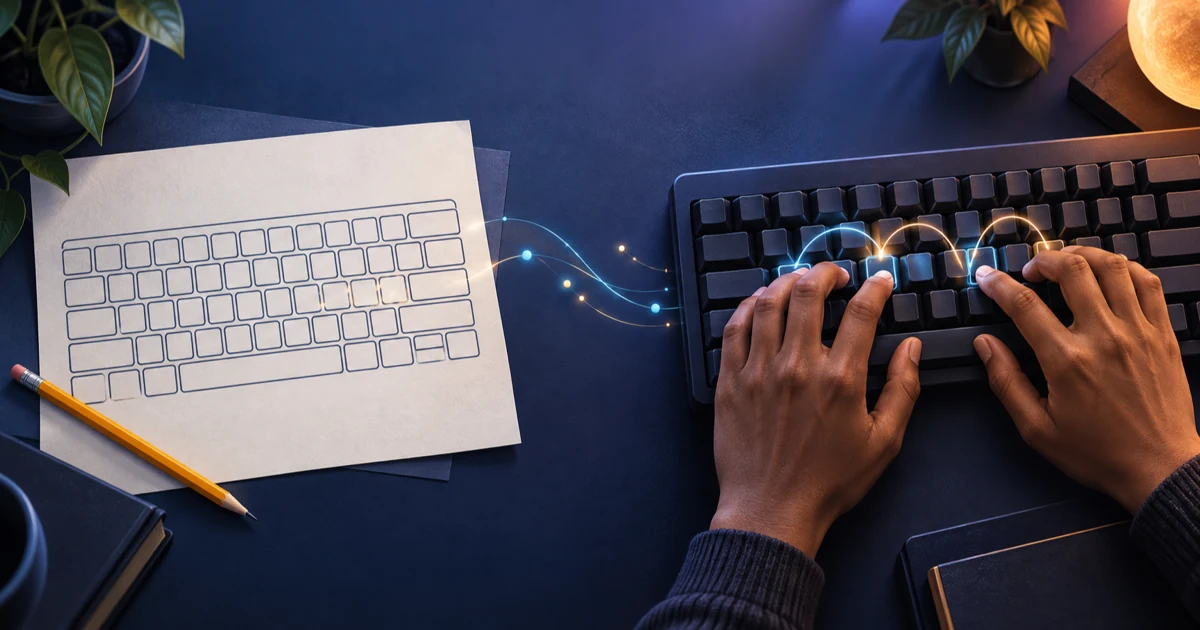
- Draw what you know for two minutes. On paper, draw three blank letter rows. Without looking at a keyboard, place as many QWERTY letters as you can. Stop at two minutes. Count correct placements only after the timer ends.
- Type what you can do for two minutes. Cover the key labels or keep your eyes on the screen. Copy ordinary prose in a local document or a typing test. Record correct WPM, accuracy, and repeated error keys. Do not compare the result with someone else's score.
- Isolate one pattern for two minutes. Choose one recurring error key or awkward pair and practice it slowly in short words. The weak-key practice route can identify and isolate repeated patterns. No universal accuracy percentage determines success; look for fewer repeats of the same error under matched conditions.
- Check transfer for two minutes. Use a new passage, not the one you just memorized. Keep the same keyboard, duration, language, and correction rules. If the isolated pattern improves without spreading errors elsewhere, keep it in your next short session. If it improves only inside the drill, add varied words before increasing speed.
Many competent typists will leave blanks on the paper keyboard while still typing useful prose. That gap is the point: explicit recall and skilled execution overlap, but they are not identical. If both parts are difficult, begin with accuracy practice rather than treating the result as a diagnosis.
How to build automaticity without the myths
Practice patterns, then verify them in context
Focused repetition can make a weak sequence easier to execute, but a drill is only the first half of practice. Follow it with varied text. This checks whether the movement survives changes in neighboring letters and words.
Keep comparisons matched
Duration, prompt type, language, correction rules, device, and fatigue can change a typing score. Compare like with like. Typing Speed RPG's methodology explains why a score is a snapshot rather than a permanent label.
Track recurring errors, not only headline WPM
A global score can hide one unstable pair or key. Use error patterns, backspaces, and consistency alongside correct WPM. The guide to typing errors and weak keys shows how to separate a narrow repeated problem from broad accuracy drift. The guide to typing metrics explains how to read the measures together.
Do not assign every typo to “bad muscle memory”
Errors can come from motor timing, visual attention, language production, device changes, fatigue, or a mismatch between the test and the real task. The evidence does not show that one accidental repetition permanently encodes a wrong movement. If an error repeats across several matched sessions, it is a useful practice target; a single slip is noise until it becomes a pattern.
Do not use a fixed calendar or WPM threshold
Research does not support one number of days required to build typing automaticity, one WPM at which typing becomes automatic, or one accuracy percentage that suits every learner and task. Track your own repeated, comparable sessions. Improvement should mean cleaner and more stable performance on the text you need, not compliance with an invented universal deadline.
What typing automaticity cannot prove
Typing a familiar passage quickly does not prove better writing, reading comprehension, coding ability, job performance, or learning. Copy typing measures the reproduction of provided text. Composition measures the production and revision of ideas. Coding includes problem solving and tool use. Accessibility needs can also make standard speed tests a poor representation of effective communication.
The research cited here is dominated by physical QWERTY keyboards, English text, transcription tasks, young or self-selected participants, and short laboratory or web sessions. The newest direct automaticity study is a preprint, not a peer-reviewed final article. Treat its findings as promising evidence, not the last word on how typing is learned.
Train a pattern, then test transfer
Which keys interrupt your flow?
Use weak-key practice to isolate a repeated problem. Then type a fresh passage under matched conditions to see whether the improvement survives outside the drill.
Find your weak-key patternsConclusion
Typing is muscle memory only as shorthand. Practice can build implicit, procedural control for key reaches and familiar sequences, allowing some movements to run with less conscious attention. But automaticity is not a complete model of typing skill, and it does not replace language, judgment, error monitoring, or task-specific knowledge.
Test the gap between what you can explain and what you can do. Then train one repeated pattern, verify it on new text, and compare matched sessions. A focused path is to run weak-key practice and follow it with a fresh speed-practice passage to see whether the change transfers.
Sources and evidence notes
Sources were reviewed September 20, 2026. Quantitative claims are limited to the linked populations, designs, and outcomes. The Automaticity Map and Know–Do Split are Typing Speed RPG editorial synthesis, not validated diagnostic tools or protocols prescribed by the researchers.
- Ruopp et al. (2026): automaticity in naturally learned typing sequences — A preprint study of 37 healthy native-English speakers found faster, less variable timing for higher-frequency words and letter pairs. Only 24 participants completed the conventional typing assessment, and automaticity measures did not map neatly onto general typing proficiency.
- Snyder et al. (2014): explicit and implicit keyboard knowledge — Four experiments found that skilled QWERTY typists could perform well despite incomplete conscious recall of key locations. The final experiment included 24 experienced QWERTY typists who briefly learned Dvorak.
- Logan and Crump (2009): hierarchical control in skilled typing — A controlled laboratory experiment found that asking skilled typists to monitor which hand should type a letter disrupted normal performance, supporting a division between higher-level control and delegated keystroke execution.
- Logan and Crump (2011): two-loop theory of skilled typewriting — A research synthesis describing an outer loop for language-level goals and an inner loop that converts selected words into ordered keystrokes.
- Crump and Logan (2010): physical feedback and skilled typing — Two experiments found worse response times, inter-key intervals, and errors on a laser-projection keyboard and altered physical keyboards, showing that skilled performance also depends on sensory and physical context.
- Feit et al. (2016): how everyday typists move — Motion capture and eye tracking from 30 everyday typists associated faster performance with more consistent finger-to-key mappings, earlier preparation, and less whole-hand motion. Formal touch-typing training did not guarantee higher speed in this small sample.
- Dhakal et al. (2018): large-scale typing behavior — An observational analysis of about 136 million keystrokes from roughly 168,000 self-selected volunteers linked faster transcription with fewer errors and more rollover. It does not establish a target speed or measure free composition.
- Cleveland Clinic (2025): medically reviewed muscle-memory overview — An accessible clinical overview classifying muscle memory as procedural, non-declarative memory stored through the nervous system rather than in the muscles, with no universal learning timetable.